Stratigraphic Nodes of the EM
General background on stratigraphic units
A stratigraphic unit in some academic scholarships is also known as locus or context. It indicates the result of an action that occurred at a specific moment in time. The result (the construction of a wall, the destruction of a roof, is the silt deposited on top of structures following a flood, the chemical change of surfaces due to a fire) in turn have a life span that ends with the moment it is defunctionalized (destroyed, abandoned, buried).
Stratigraphic units that are of different types: real stratigraphic unit relating to something still existing or stratigraphically documented, documentary stratigraphic tip that the family of virtual stratigraphic units (relating to objects that no longer exist and need to be reconstructed). Abstract limits that are of different types: real stratigraphic unit relating to something still existing or stratigraphically documented, documentary stratigraphic tip that the family of virtual stratigraphic units (relating to objects that no longer exist and need to be reconstructed)
Stratigraphic Unit - US
It is the graphic and conceptual sign we use to number and define objects found still in situ (and noted using the techniques of stratigraphic reading).
USV/s - Structural Virtual Stratigraphic Unit node:
Lorem ipsum [definition]
Example of USV/s (structural virtual stratigraphic unit)
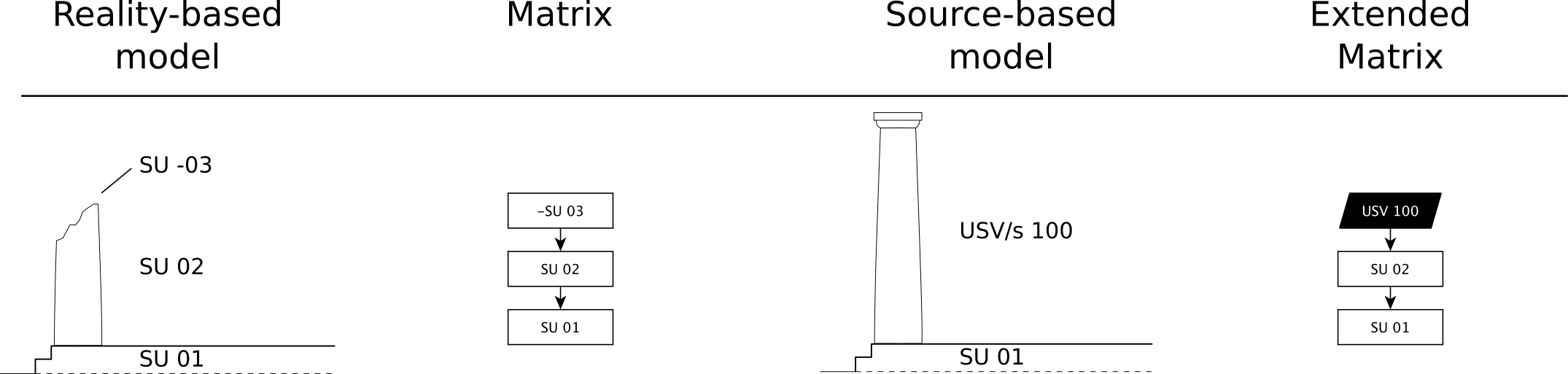
On top of a podium SU01 there is a SU02 (in situ), fragmented due to a -SU03 (destruction of the upper part of the column). A USV/s 100 hypothetical reconstruction is provisioned in order to restore the action of destruction -SU03.
USV/n node:
Lorem ipsum [definition]
Example of USV/n (non structural virtual stratigraphic unit)
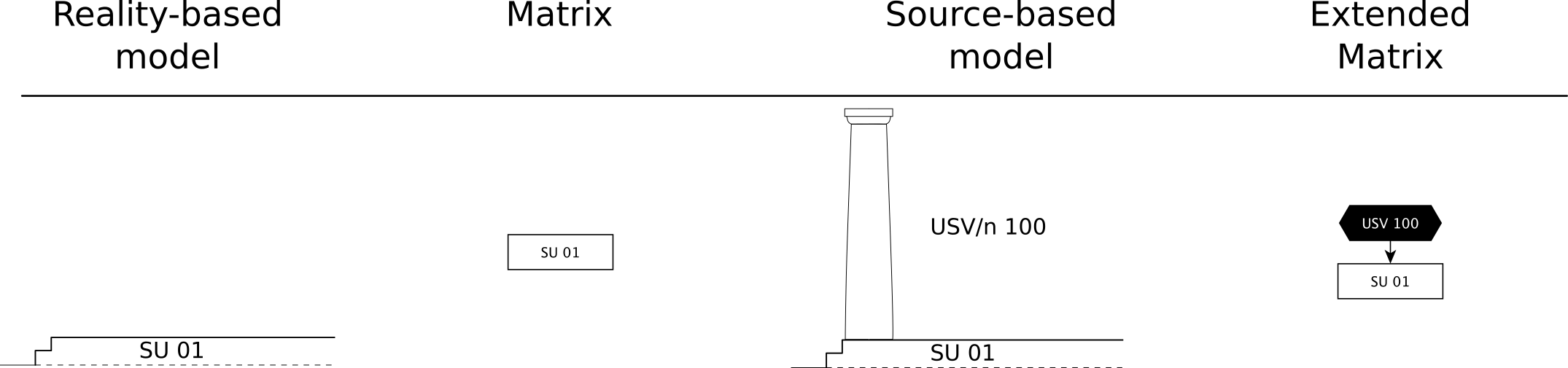
There are only the remains of a podium SU01. A USV/n 100 hypothetical reconstruction is provisioned (without physical destruction signs that prove the presence of a column).
USV series node:
Lorem ipsum [definition]
Example of a series of USV/n (non structural virtual stratigraphic unit)
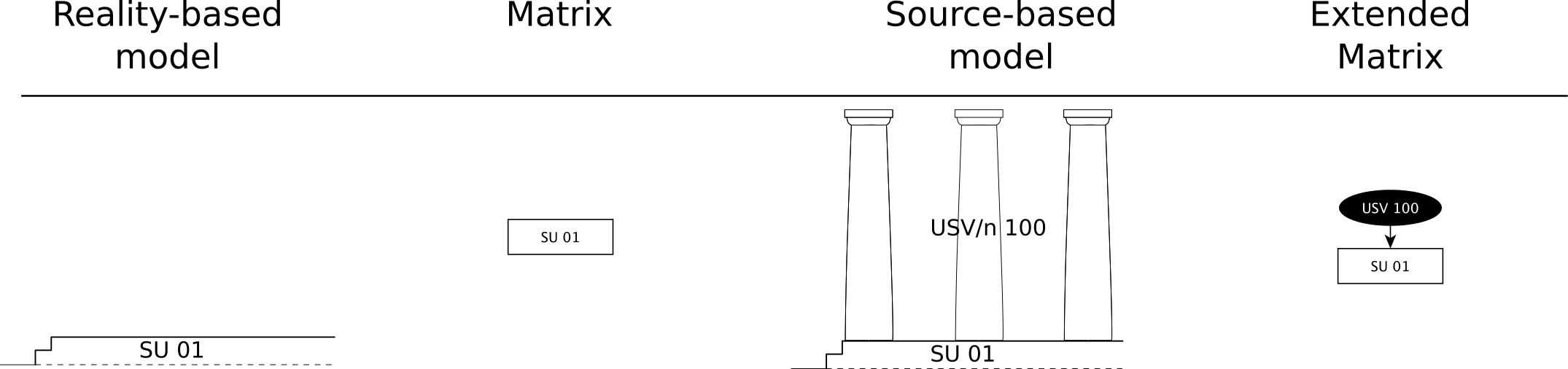
There are only the remains of a podium SU01. A USV/n 100 hypothetical reconstruction series of columns is provisioned (without physical destruction signs that prove the presence of a column). The series node allows to instance several USV/n at once.
Example of a USV/s and a series of USV/n

On top of a podium SU01 there is a column SU02 (in situ) fragmented due to a -SU03 (destruction of the upper part of the column). A USV/s 100 hypothetical reconstruction is provisioned in order to restore the destruction’s action -SU03. A series USV/n 101 is provided in order to complete the peristasis of the temple.
Special Find node:
Lorem Ipsum [definition]
Example of a USV/n based on Special Finds (non in situ) elements
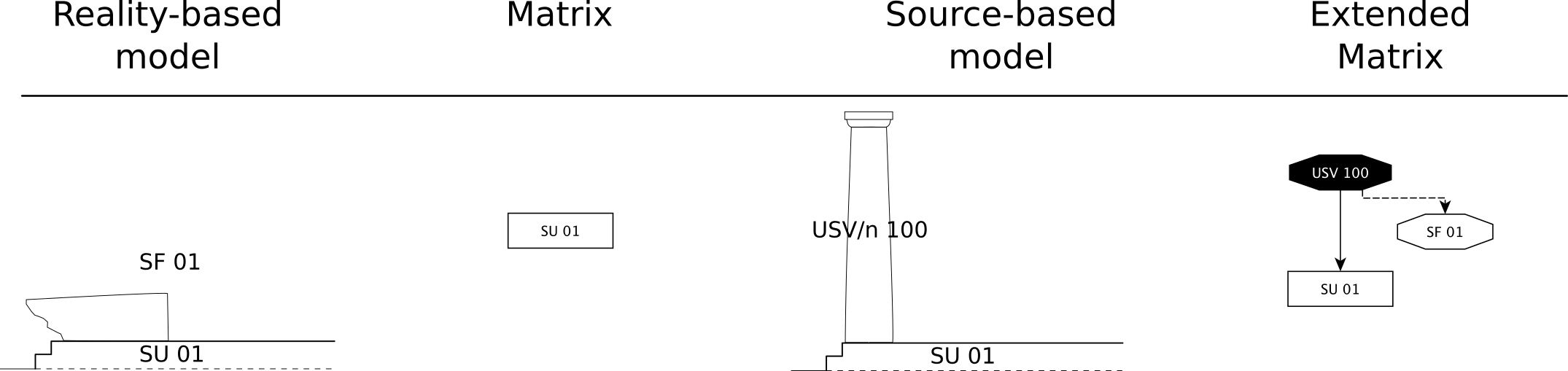
There are only the remains of a podium SU01 with a collapsed column SF01. A USV/n 100 hypothetical reconstruction is provisioned using the SF as a source. This kind of USV/n has a special status: see “USV and validation nodes” section on top of this page.
Example of a USV/n series based on Special Finds (non in situ) elements

There are only the remains of a podium SU01 with a collapsed column SF01 (special find 01). A USV/n 100 series hypothetical reconstruction of the columnade is provisioned using the SF as a source.
Cumulative example of different USV nodes used togheter
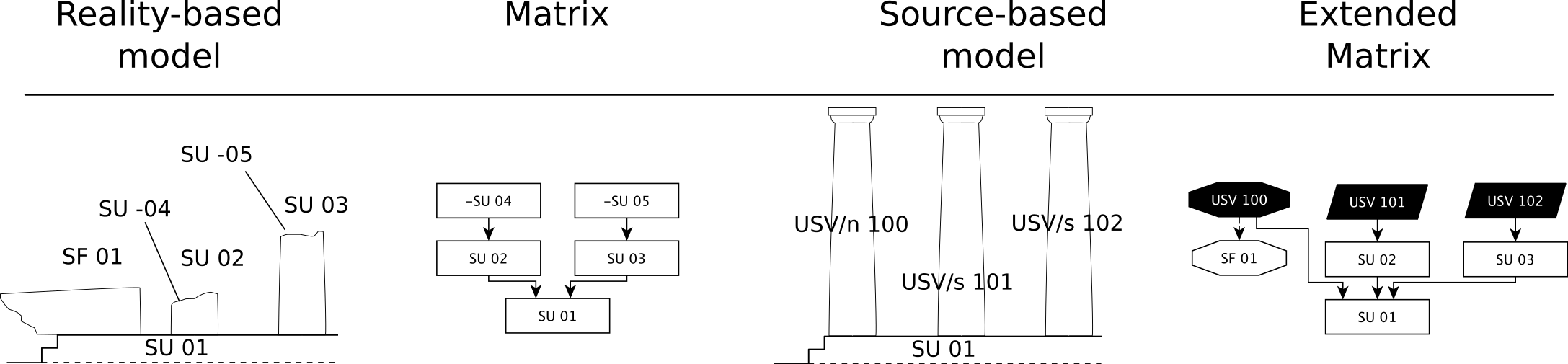
USV/s and USV/n are used togheter. Different -SU allow to propose different USV/s.
Documentary Stratigraphic Unit - USD
The Documentary Stratigraphic Unit (USD) represents an element whose existence is certain due to a source considered reliable (a text, a drawing).
It connects to these properties:
existence
geometry
placement
material
color
etc..
Transformation Stratigraphic Unit - TSU
Lorem Ipsum
It connects to these properties:
existence
geometry
placement
material
color
etc..